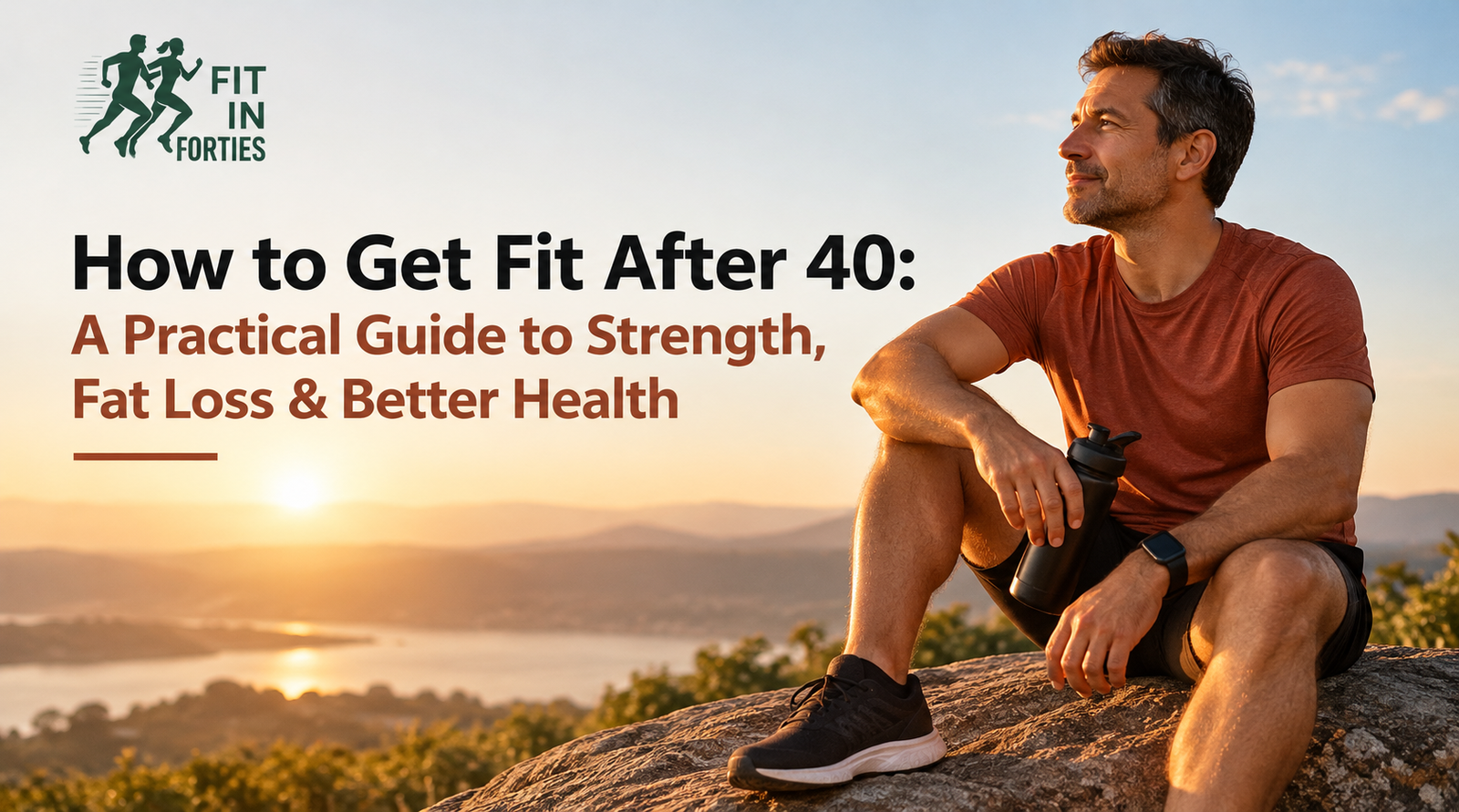
How to Get Fit After 40
If you’re wondering how to get fit after 40, the answer starts with building strength, improving cardiovascular fitness and creating habits you can maintain.
Turning 40 doesn’t mean your best years of fitness are behind you.
In fact, your 40s can be the decade when you become stronger, leaner, more energetic, and more intentional about your health.
But the way you approach fitness may need to change.
You don’t necessarily need harder workouts. You need better training, better recovery, better nutrition and better consistency.
The goal isn’t to spend every evening in a gym or follow an extreme diet for eight weeks.
It’s to build a body that is strong enough for everyday life, fit enough to handle physical activity, mobile enough to move well and healthy enough to support the life you want for the next few decades.
Research and public-health guidelines consistently point toward the same basic ingredients: regular physical activity, resistance training, appropriate nutrition, adequate protein, good sleep and less sedentary time.
So if you’re wondering how to get fit after 40, start with the fundamentals.
How to Get Fit After 40: What It Actually Means
Fitness is bigger than your weight.
A person can lose 10 pounds and still have poor fitness.
Another person can remain around the same weight while gaining muscle, becoming stronger, improving cardiovascular fitness and reducing body fat.
That’s why fitness after 40 should be measured by more than the bathroom scale.
Think about these six areas:
1. Strength
Can you lift, carry, push, pull, squat and climb stairs comfortably?
2. Muscle
Are you maintaining the muscle you already have?
3. Cardiovascular fitness
Can you walk briskly, cycle, swim or climb several flights of stairs without becoming excessively breathless?
4. Mobility
Can you move through the ranges of motion you need for everyday life?
5. Body composition
Are you managing body fat while maintaining useful lean mass?
6. Recovery
Can you train, sleep and recover well enough to repeat your routine?
This is the bigger picture.
The goal after 40 isn’t simply to weigh less. It’s to become more physically capable.
Why Fitness Matters More After 40
You don’t suddenly become unhealthy on your 40th birthday. Ageing is gradual.
But over the years, changes in activity levels, muscle, strength, body composition, sleep and lifestyle can make staying fit more challenging.
The World Health Organization’s Guidelines on Physical Activity and Sedentary Behaviour recommend that adults accumulate 150–300 minutes of moderate-intensity aerobic activity per week, or 75–150 minutes of vigorous activity, together with muscle-strengthening activity involving the major muscle groups on at least two days each week.
WHO also emphasizes that some physical activity is better than none and that people who are inactive can start with smaller amounts and gradually increase.
The 7 Foundations of Getting Fit After 40
- Strength training
- Cardiovascular fitness
- Daily movement
- Adequate protein and good nutrition
- Healthy body composition
- Sleep and recovery
- Consistency
You don’t need to master all seven immediately. Build them one at a time.
1. Make Strength Training a Priority
If you’re over 40 and want to stay physically capable, resistance training deserves a permanent place in your routine.
That doesn’t necessarily mean joining a gym. You can use dumbbells, barbells, resistance bands, machines, kettlebells or bodyweight exercises.
The equipment isn’t the most important part. The important part is giving your muscles a progressively challenging stimulus.
A systematic review and meta-analysis of 22 randomized controlled trials found that resistance training significantly improved muscle strength in very elderly adults, including adults aged 80 and older. The findings also showed an effect on whole-muscle hypertrophy.
Another systematic review and meta-analysis of 21 studies involving 1,610 adults aged 60 and older found improvements in physical functioning, several measures of muscle strength, mental health and other quality-of-life outcomes following resistance training.
In other words:
It’s never too late to get stronger.
What Should You Train?
You don’t need dozens of exercises. Focus on the major movement patterns.
Lower body
- Squats
- Split squats
- Lunges
- Step-ups
- Hip hinges
- Romanian deadlifts
Push
- Push-ups
- Bench press
- Dumbbell press
- Overhead press
Pull
- Rows
- Lat pulldowns
- Pull-ups
- Resistance-band rows
Core
- Planks
- Dead bugs
- Carries
- Controlled rotational movements
A simple full-body routine performed consistently can be more useful than an elaborate program that you abandon after three weeks.
How Often Should You Strength Train After 40?
For many beginners, two full-body strength sessions per week is an excellent starting point. Three sessions can work well once you’ve established the habit and can recover adequately.
WHO recommends muscle-strengthening activity involving all major muscle groups on two or more days per week.
A 2025 systematic review and network meta-analysis covering 151 randomized trials and 6,306 older adults found that relatively low resistance-training volumes could substantially improve physical function, lean body mass and muscle size, while higher volumes appeared more useful for maximizing some strength outcomes.
The lesson isn’t that you should always train with low volume. The lesson is simpler:
You can make meaningful progress without living in the gym.
2. Build Your Cardiovascular Fitness
Strength is only half of physical fitness. Your heart and lungs need training too.
Cardiorespiratory fitness is strongly associated with long-term health outcomes.
A dose-response meta-analysis of 34 cohort studies found inverse associations between cardiorespiratory fitness and mortality from all causes, cardiovascular disease and cancer.
You don’t need to become a marathon runner.
Useful options include:
- Brisk walking
- Cycling
- Swimming
- Jogging
- Hiking
- Rowing
- Dancing
- Sports
- Intervals when appropriate
Choose something you can actually continue.
How Much Cardio Do You Need After 40?
The basic WHO target for adults is 150–300 minutes of moderate-intensity aerobic activity per week or 75–150 minutes of vigorous-intensity activity per week, or an equivalent combination.
That may sound like a lot if you’re currently inactive. Don’t let the number stop you.
If you’re starting from almost zero, begin with 10–20 minutes of walking. Then gradually increase.
A simple progression
- Week 1: 10–15 minutes, 4 days
- Week 2: 15–20 minutes, 4–5 days
- Week 3: 20–25 minutes, 5 days
- Week 4: 25–30 minutes, 5 days
The exact progression isn’t important. The principle is.
Start where you are and build from there.
3. Don’t Confuse Exercise With Movement
You can exercise for 45 minutes and still spend most of your waking day sitting.
That’s why daily movement matters.
Walking to the store. Taking the stairs. Standing up regularly. Walking during phone calls. Doing household tasks. Taking a short walk after meals.
None of these replaces structured exercise. But they can help you become a more active person overall.
WHO recommends limiting sedentary time and replacing sedentary time with physical activity of any intensity, including light-intensity activity.
There is no magic number of steps that everyone must hit.
Instead, ask:
How can I move more than I currently do?
4. Eat Enough Protein
If your goal is to become leaner while maintaining or building muscle, protein deserves special attention.
Protein supplies amino acids required for maintaining and building muscle tissue, and resistance training and protein work together.
A systematic review and meta-analysis of 49 studies involving 1,863 participants found that protein supplementation increased gains in muscle strength and fat-free mass during prolonged resistance training. The researchers reported that benefits to fat-free mass did not continue to increase beyond a total protein intake of approximately 1.6 g/kg/day in the conditions studied.
That does not mean everyone needs exactly 1.6 g/kg.
Your appropriate intake depends on your body size, activity, goals, diet and overall circumstances.
But it reinforces a useful principle:
Active adults should pay deliberate attention to protein rather than treating it as an afterthought.
Good Protein Sources
Depending on your dietary preferences, useful protein sources can include:
- Greek yogurt
- Cottage cheese
- Milk
- Eggs
- Fish
- Lean meat
- Tofu
- Tempeh
- Soy foods
- Lentils
- Beans
- Peas
- Protein powders
If you’re vegetarian, reaching a higher protein intake can require more planning. That doesn’t mean it’s difficult. It simply means protein should be deliberately included in meals rather than added only when you remember it. Protein Calculator
5. Lose Fat Without Sacrificing Muscle
A common mistake after 40 is to make the goal simply: “I need to lose weight.”
But weight loss and fat loss aren’t identical goals.
If you lose weight rapidly while eating too little protein and doing little resistance training, you may lose lean tissue along with fat.
For many people, the better target is:
Reduce excess body fat while preserving or building muscle.
That usually means combining:
- A sensible calorie deficit when fat loss is needed
- Resistance training
- Adequate protein
- Regular movement
- Good sleep
- Patience
You don’t need to starve yourself. You don’t need to eliminate carbohydrates. You don’t need to survive on salads. TDEE Calculator
You need a nutritional pattern that creates an appropriate energy balance while giving your body enough nutrients to function and train. Macro Calculator
6. Stop Chasing the Lowest Possible Body Weight
The scale is useful. But it isn’t the whole story.
Imagine two people who both weigh 75 kg.
One has less muscle, more body fat, low strength and poor cardiovascular fitness.
The other has more muscle, less body fat, better strength and better cardiovascular fitness.
Same body weight. Very different bodies.
This is why body composition becomes increasingly useful when evaluating fitness.
Track more than weight:
- Waist measurement
- Strength
- Fitness
- Energy
- Mobility
- Progress photos
- How your clothes fit
- Workout performance
Your weight may stay relatively stable while your body composition improves.
7. Sleep Is Part of Your Fitness Plan
Sleep is not something you deal with after everything else is finished. It is part of recovery.
The American Academy of Sleep Medicine and Sleep Research Society consensus statement recommends that healthy adults regularly obtain at least seven hours of sleep per night to promote optimal health.
Build a sleep-friendly routine
- Keep a reasonably consistent sleep schedule.
- Give yourself enough time in bed.
- Keep the bedroom dark and comfortable.
- Avoid excessive caffeine late in the day.
- Reduce stimulating activities close to bedtime.
- Avoid letting work consume the entire period before sleep.
- Address persistent sleep problems rather than simply accepting them.
Fitness isn’t just what happens during your workout.
Recovery determines how well you can keep doing the work. Sleep and Recovery Assessment
What About Mobility?
You don’t need to spend an hour stretching every day.
But you should be able to perform the movements your life requires.
Think about:
- Squatting down
- Getting up from the floor
- Reaching overhead
- Rotating your torso
- Walking comfortably
- Bending and lifting
- Getting in and out of a car
Strength training performed through appropriate ranges of motion can contribute to useful movement capacity. You can also add short mobility sessions around your workouts or throughout the week.
The objective isn’t to become unusually flexible. It’s to remain capable and comfortable in your normal movements.
The Biggest Fitness Mistake After 40
It’s not missing one workout.
It’s trying to make up for years of inactivity in one month.
A typical cycle looks like this:
Monday: “I’m finally getting serious.”
Two-hour workout.
Tuesday: Everything hurts.
Wednesday: No workout.
Thursday: Motivation disappears.
Friday: Back to normal life.
The problem isn’t necessarily the lack of motivation. The problem is an unsustainable strategy.
The Better Strategy: Progress Gradually
Fitness works through repeated exposure.
Start with something manageable.
Then gradually increase:
- Resistance
- Repetitions
- Sets
- Duration
- Distance
- Exercise difficulty
- Training frequency
You don’t have to increase everything at once.
If you can perform an exercise comfortably with good technique, you might add a few repetitions or a small amount of resistance.
If a workout leaves you unable to function for several days, it may have been too much.
The goal is not to prove how hard you can train once. The goal is to become someone who can train consistently.
What If You Haven’t Exercised in Years?
Don’t start by copying someone’s advanced workout.
Start at your current level.
A simple beginner week
Monday: 20-minute walk + 15-minute basic strength session
Tuesday: 20–30-minute walk
Wednesday: Rest or easy movement
Thursday: 20-minute walk + 15-minute strength session
Friday: Easy walk
Saturday: Longer comfortable walk
Sunday: Recovery
That’s enough to begin.
Once your body adapts, increase gradually.
The first goal isn’t transformation. The first goal is making movement normal again.
A Simple 30-Minute Strength Workout After 40
You don’t need a complicated gym program.
- Squat or chair squat: 2–3 sets
- Push-up or chest press: 2–3 sets
- Row: 2–3 sets
- Hip hinge or Romanian deadlift: 2–3 sets
- Overhead press: 2 sets
- Core exercise: 2 sets
Rest as needed between sets. Choose resistance that allows controlled repetitions with good technique.
If you’re completely new to resistance training, start conservatively and focus on learning the movement patterns.
A Simple Weekly Fitness Plan
Monday
Full-body strength — 30–45 minutes
Tuesday
Brisk walk or cardio — 25–40 minutes
Wednesday
Full-body strength — 30–45 minutes
Thursday
Walking + mobility
Friday
Full-body strength — 30–45 minutes
Saturday
Longer enjoyable activity — walking, cycling, swimming, hiking or sport.
Sunday
Recovery + normal movement
This is only a framework. If three strength sessions are too much, start with two. If you enjoy daily walking, walk more. If you have limited time, shorten the sessions.
The best program is the one that fits your actual life.
What Should You Eat After 40?
You don’t need a “40+ diet.” You need a generally nutritious diet that supports your goals.
A simple plate can include:
Protein: A meaningful protein source.
Vegetables: A variety of vegetables.
Fruit: One or more servings according to your overall diet.
High-fibre carbohydrates: Whole grains, legumes, potatoes or other minimally processed carbohydrate sources.
Healthy fats: Nuts, seeds, avocado and appropriate oils.
The exact proportions depend on your calorie needs and goals.
If fat loss is the goal, total energy intake matters. If muscle gain is the goal, adequate calories and protein matter. If health and maintenance are the goal, a sustainable balanced diet may be sufficient.
There is no single perfect diet for everyone over 40.
Do You Need Supplements?
Not necessarily.
Supplements should support a good lifestyle—not replace one.
Before thinking about supplements, ask:
- Am I training consistently?
- Am I eating enough protein?
- Am I eating a reasonably nutritious diet?
- Am I getting enough sleep?
- Am I moving regularly?
- Am I managing my calorie intake appropriately?
If the basics aren’t in place, a supplement is unlikely to solve the real problem.
Some people may benefit from specific supplements depending on their diet, deficiencies, goals or circumstances. But supplementation should be purpose-driven, not simply because something is marketed as a “must-have after 40.”
What About Joint Pain?
Getting older does not mean you have to accept every ache as inevitable. But it also doesn’t mean you should ignore pain.
Normal training discomfort and muscle fatigue are different from sharp, severe, persistent or worsening pain.
If an exercise consistently causes pain, modify the resistance, range of motion, exercise selection, technique, training volume or frequency.
If pain is persistent, severe or concerning, get it appropriately assessed rather than repeatedly training through it.
Fitness should help you become more capable—not constantly injured.
The Mental Shift That Changes Everything After 40
At 25, fitness might have been about looking good for a holiday. At 40, that can still be a perfectly valid goal.
But there is something bigger.
You are building the physical capacity you want to have at 50, 60 and 70.
Think about being able to:
- Carry your luggage without struggling.
- Walk around a new city all day.
- Climb stairs without fear.
- Get up from the floor easily.
- Play with your children or grandchildren.
- Travel comfortably.
- Maintain independence.
- Continue doing the activities you enjoy.
That’s what fitness can ultimately give you.
Not just a better-looking body. A more capable life.
Your Fit After 40 Checklist
Movement
- ☐ I moved my body most days this week.
- ☐ I avoided spending the entire day sitting.
- ☐ I walked regularly.
Strength
- ☐ I completed at least two strength sessions.
- ☐ I trained the major muscle groups.
- ☐ I gradually progressed or maintained my training.
Cardio
- ☐ I performed regular aerobic activity.
- ☐ My cardiovascular fitness is improving or being maintained.
Nutrition
- ☐ I included protein-rich foods throughout the day.
- ☐ I ate a variety of nutrient-dense foods.
- ☐ My calorie intake matches my current goal.
Recovery
- ☐ I gave myself enough opportunity to sleep.
- ☐ I allowed recovery between harder sessions.
- ☐ I paid attention to persistent pain or excessive fatigue.
Consistency
- ☐ My routine was realistic enough to repeat next week.
That’s the part that matters most.
A 12-Week Roadmap to Getting Fit After 40
Weeks 1–4: Build the habit
- Two strength sessions each week
- Regular walking
- Improving meal quality
- Including protein consistently
- Establishing a better sleep routine
Don’t chase perfection.
Weeks 5–8: Build capacity
Gradually increase walking duration, training resistance, exercise repetitions and, when appropriate, cardio intensity.
Start tracking your progress.
Weeks 9–12: Start optimizing
- Strength progression
- Waist measurement
- Body-weight trend
- Cardio performance
- Sleep consistency
- Protein intake
- Recovery
At this stage, you should have enough information to see what is actually working.
How Do You Know If You’re Getting Fitter?
Don’t rely on the scale alone.
Strength: You’re lifting more or performing more repetitions.
Endurance: You can walk, cycle or exercise longer.
Recovery: You recover more comfortably between sessions.
Movement: Everyday activities feel easier.
Body composition: Your waist or body-fat trend is improving.
Energy: You feel more capable during the day.
Consistency: Exercise has become part of your normal week.
These are meaningful wins.
The FitInForties Approach
At FitInForties, we don’t believe fitness after 40 should be about chasing a perfect body.
It’s about understanding the whole picture.
Your movement. Your strength. Your food. Your sleep. Your stress. Your daily habits. Your progress.
That is why FitInForties looks beyond a single number.
Your Body Performance Index (BPI) is designed to bring different aspects of your lifestyle together so you can understand where you are today and what you can work on next.
Instead of asking:
“What’s wrong with me?”
The better question is:
“What can I improve next?”
That’s a much more useful way to approach your 40s.
Discover Your BPI.
The Bottom Line: Getting Fit After 40 Is Simpler Than You Think
You don’t need to punish yourself.
You don’t need to starve yourself.
You don’t need six workouts every week.
You don’t need to become obsessed with fitness.
Start with the fundamentals.
Strength train at least twice a week.
Build your cardiovascular fitness.
Move more throughout the day.
Eat enough protein and build a nutritious diet.
Manage body fat without sacrificing muscle.
Prioritize sleep and recovery.
Progress gradually.
Stay consistent.
The WHO message is remarkably practical: if you aren’t currently meeting the recommended activity levels, start with small amounts and gradually increase.
You don’t have to become fit overnight.
You simply have to become a little more capable than you were before.
Then do it again tomorrow.
Because the real goal of fitness after 40 isn’t to turn back the clock.
It’s to make sure the next 20 or 30 years are lived in a body you can rely on.
Learning how to get fit after 40 isn’t about doing everything at once. It’s about building a routine your future self can keep.
Frequently Asked Questions
Is it possible to get fit after 40?
Yes. Adults can improve strength, cardiovascular fitness, physical function and body composition through appropriate training, nutrition and lifestyle habits. Research on resistance training shows that meaningful strength improvements remain possible even in much older adults.
What is the best exercise after 40?
There isn’t one best exercise. A well-rounded approach combines resistance training, aerobic activity and regular daily movement.
How many days a week should I work out after 40?
Two or three resistance-training sessions per week is a practical starting point for many people. Add regular aerobic activity and daily movement according to your fitness level and schedule.
Can you build muscle after 40?
Yes. Resistance training provides the primary stimulus for muscle growth and strength, and adequate protein can support the adaptation to training.
How much protein should I eat after 40?
There is no single number that applies to everyone. Protein needs depend on body size, activity, goals, age and diet. Research in resistance-trained adults found that benefits to fat-free mass plateaued around 1.6 g/kg/day in the specific population and conditions studied.
Is cardio or strength training better after 40?
Neither replaces the other. Strength training helps maintain and develop muscular fitness, while aerobic activity develops cardiovascular fitness. A combination is generally more useful than choosing only one.
How can I lose belly fat after 40?
You cannot reliably choose where your body loses fat first. Overall fat loss comes from sustained energy balance over time. A combination of appropriate calorie intake, resistance training, adequate protein and regular movement can help improve body composition.
How much sleep should I get after 40?
The American Academy of Sleep Medicine and Sleep Research Society recommend that healthy adults regularly obtain at least seven hours of sleep per night. Individual needs vary.
What if I haven’t exercised in years?
Start small. Walking and two manageable strength sessions per week can be a practical starting point. Increase gradually rather than trying to make up for years of inactivity in a few weeks.
Do I need a gym to get fit after 40?
No. Effective resistance training can be performed with dumbbells, resistance bands, bodyweight exercises or other equipment. The important factor is providing your muscles with an appropriate progressive challenge.
Is it too late to get fit at 40?
Absolutely not. Your fitness today is not a permanent verdict on your future. You can start where you are and improve from there.
Research & Sources
World Health Organization — Guidelines on Physical Activity and Sedentary Behaviour
Grgic et al. — Effects of Resistance Training on Muscle Size and Strength in Very Elderly Adults
Kashi et al. — Resistance Training, Quality of Life and Physical Function in Older Adults
Radaelli et al. — Resistance Training Volume in Older Adults, 2025
Han et al. — Cardiorespiratory Fitness and Mortality
Morton et al. — Protein Supplementation and Resistance Training
American Academy of Sleep Medicine & Sleep Research Society — Adult Sleep Duration Consensus
Important Note
FitInForties provides general educational information about fitness, nutrition, lifestyle and wellness. This article is not intended to diagnose, treat or prevent any medical condition. If you have a medical condition, significant symptoms, an injury, or concerns about starting exercise, seek advice from an appropriately qualified healthcare professional.
